
Haifa climbs the northern slope of Mount Carmel down to the Mediterranean, so almost every street ends in a view of the bay. It is Israel’s third-largest city and a working port, home to Jews and Arabs, Christians and Muslims, and to the world center of the Baha’i faith. That mix gives Haifa a relaxed, everyday character that many visitors find refreshing after Jerusalem.
Many tours stop only for a photo of the Baha’i Gardens and drive on. Give the city a full day, or use it as a base for two nights, and you can add the neighborhoods, the monasteries on the mountain, the Carmel trails and the old city of Acre across the bay.
1. The Baha’i Gardens and the Shrine of the Báb
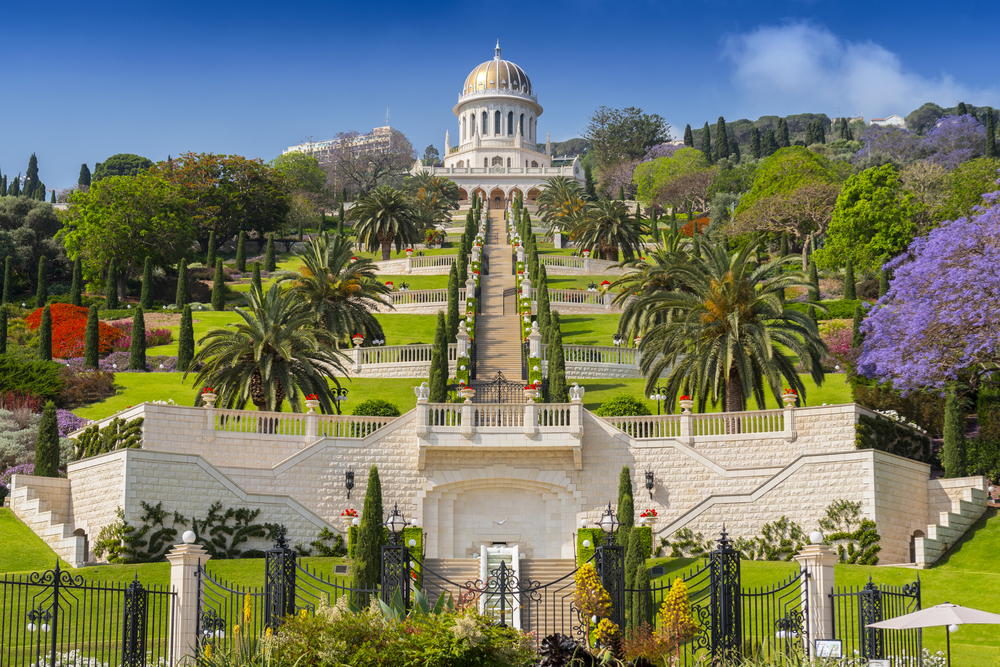
The gardens are Haifa’s signature sight: nineteen terraces of lawns, flowerbeds and fountains running down the mountain in a straight line, with the gold-domed Shrine of the Báb at their center. The Báb was the forerunner of the Baha’i faith, and his shrine is one of its holiest places. Together with the shrine of Bahá’u’lláh near Acre, the gardens are a UNESCO World Heritage Site.
It helps to know how a visit works, because you cannot simply wander the whole slope:
- The upper terraces are seen on a free guided walking tour that starts at the top of the mountain and walks down through the gardens. Tours run by advance reservation only and places are limited, so book ahead.
- The middle terraces around the Shrine of the Báb are open for self-guided visits on most days. The shrine itself opens for shorter hours. You remove your shoes, dress modestly with shoulders and knees covered, and keep silent inside.
- The lower terraces are open for self-guided visits from the plaza at the top of Ben Gurion Boulevard, in the German Colony.
- The administrative buildings of the Baha’i World Centre, on the arc above the shrine, are not part of the public visit.
The gardens close on Baha’i holy days and Yom Kippur, and sometimes in rainy weather, and the guided tours do not run every day, so this is one visit worth timing with someone who checks the day’s schedule. Food, smoking and pets are not allowed, though you may bring a bottle of water.
2. The Louis Promenade
For the classic photograph, walk along the Louis Promenade on Yefe Nof Street, at the top of the gardens. The path runs along the ridge for a few hundred meters, and from it you look straight down the terraces to the port, across the bay to Acre and, on a clear day, to the hills of the Galilee. Come early in the morning for soft light, or at sunset, when the city lights come on below you.
3. The German Colony
At the foot of the gardens, Ben Gurion Boulevard runs straight toward the sea, lined with restored stone houses. They were built from 1869 by the Templers, a German Protestant movement who settled in the Holy Land to wait for the return of Christ. They have no connection to the medieval Knights Templar. Look above the doors of some houses for verses from the Bible carved in German.
Today the boulevard is Haifa’s main street for eating out, with restaurants, cafes and bars in the old houses, and it is one of the liveliest places in the city in the evening. Walk up the boulevard toward the gardens after dark, when the terraces are lit.
4. Wadi Nisnas
A few minutes’ walk from the German Colony, Wadi Nisnas is an Arab neighborhood of narrow lanes and stone stairways. Its small market sells fresh produce, olives, spices, coffee and Arab sweets, and the bakeries and falafel stands make it a good place for a casual lunch. Look out for the sculptures and murals set into walls and courtyards around the neighborhood.
Many shops here stay open on Saturday, when much of Jewish Haifa slows down for Shabbat. In December, the neighborhood has in many years hosted a festival celebrating the holidays of the season together. Check whether it runs during your visit. A guided food walk here is one of the easiest ways to taste the city, and it fits well into our culinary tours.
5. Stella Maris and Elijah’s Cave
On the western tip of Mount Carmel, high above the sea, stands the Stella Maris Monastery of the Carmelite order. The Carmelites take their name from this mountain, where hermits first gathered in the 12th century in memory of the prophet Elijah. The present church dates from the 19th century and is built over a grotto linked with Elijah. Inside, the painted dome shows Elijah, other prophets and the Holy Family.
Below the monastery, near the foot of the mountain, Elijah’s Cave is a place of prayer for Jews, Christians, Muslims and Druze, with separate sections for men and women. Modest dress is expected at both sites. A cable car has linked the Bat Galim beach promenade with the monastery for many years; check whether it is running.
6. Mount Carmel and the Druze Villages
Behind the city, the Carmel ridge is a large national park of pine and oak forest, with marked trails, picnic spots and lookouts. Easy walks in the area known as Little Switzerland suit families, and the Nahal Me’arot caves on the western slopes are a UNESCO World Heritage Site for what they reveal about early humans.
At Muhraka, a Carmelite monastery marks the place where, by tradition, Elijah challenged the prophets of Baal. The roof looks out over the Jezreel Valley, one of the widest views in northern Israel. Nearby, the Druze villages of Daliyat al-Karmel and Isfiya welcome visitors to their markets and restaurants. Lunch at a Druze family restaurant, with fresh pita from the griddle, is a good way to meet a community most visitors know little about.
7. Museums for a Hot or Rainy Afternoon
Haifa has more museums than most visitors expect. The Haifa Museum of Art, close to Wadi Nisnas, shows contemporary Israeli and international art. The Tikotin Museum of Japanese Art on the Carmel is the only museum of its kind in the region. Families enjoy MadaTech, the national science museum, set in the original Technion building, and history lovers can visit the National Maritime Museum or the Clandestine Immigration and Naval Museum, checking opening days first. Our art tours often pair the city’s museums with the artists’ village of Ein Hod on the Carmel slopes.
8. The Beaches
After a day of climbing hills, Haifa’s beaches are a good place to end it. Bat Galim, below Stella Maris, has a promenade with cafes and a calmer feel, while the long beaches south of the city, such as Dado and Zamir, have lifeguards in season, lawns and plenty of space. Hof HaCarmel train station is close to the sand if you arrive by rail.
A Day Trip to Acre
Acre, or Akko, sits across the bay, around half an hour’s drive north, and the two cities pair naturally. Its walled old city is a UNESCO World Heritage Site, with the vaulted Knights’ Halls of the Crusader fortress, the Templars’ Tunnel, the green-domed al-Jazzar Mosque and a busy market by the harbor. Just outside town, the Shrine of Bahá’u’lláh at Bahji, the holiest place in the Baha’i faith, stands in formal gardens that are open to visitors.
A good plan is the Baha’i Gardens and the German Colony in the morning, then Acre for the afternoon and a fish dinner by the harbor. Our guide to cities to visit in Israel has more on Acre.
Getting Around and Planning Your Time
- One day or two. One full day covers the gardens, the German Colony, Wadi Nisnas and Stella Maris. Stay two nights to add Acre and the Carmel.
- Check conditions near your dates. Conditions in northern Israel, including Haifa and Acre, can change, so confirm your plans close to travel. Our safety and flexibility page explains how changes are handled.
- Use the Carmelit. This short underground funicular climbs from downtown to the Carmel Center, and saves a steep walk.
- Think about Shabbat. Haifa is quieter than Tel Aviv on Friday evening and Saturday, but the Arab neighborhoods and many restaurants stay open, and the city’s public transport keeps more service than most.
- Combine with the coast. Caesarea and the wineries around Zichron Ya’akov are on the way between Tel Aviv and Haifa. See our Israel wine tour guide for the wine route.
Explore Haifa with a Private Guide
Haifa and Acre appear in many of the trips we build, from Holy Land tours that include Stella Maris and Muhraka to food and art days on the Carmel. Our guides are licensed by Israel’s Ministry of Tourism, and we shape every day around your interests and pace, so you can linger in the gardens or spend the afternoon in the market.
Tell us when you are traveling and what interests you most, and we will plan your days in Haifa and the north around it. Get a free quote.
Frequently Asked Questions
Can you visit the Baha’i Gardens for free?
Yes. Entry to the gardens is free, and so are the guided tours of the upper terraces. Places on the tours are limited and must be booked ahead, and the gardens close on Baha’i holy days, so check the schedule before you go.
How many days do you need in Haifa?
One full day is enough for the main sights in the city. Plan two nights if you also want to visit Acre, walk on Mount Carmel or have lunch in a Druze village.
What should I wear to the Baha’i Gardens?
Cover your shoulders and knees, as you would at other holy sites in Israel. You will take off your shoes at the Shrine of the Báb, so shoes that slip on and off easily help.
Related reading: The Best Things to Do in Nazareth.