
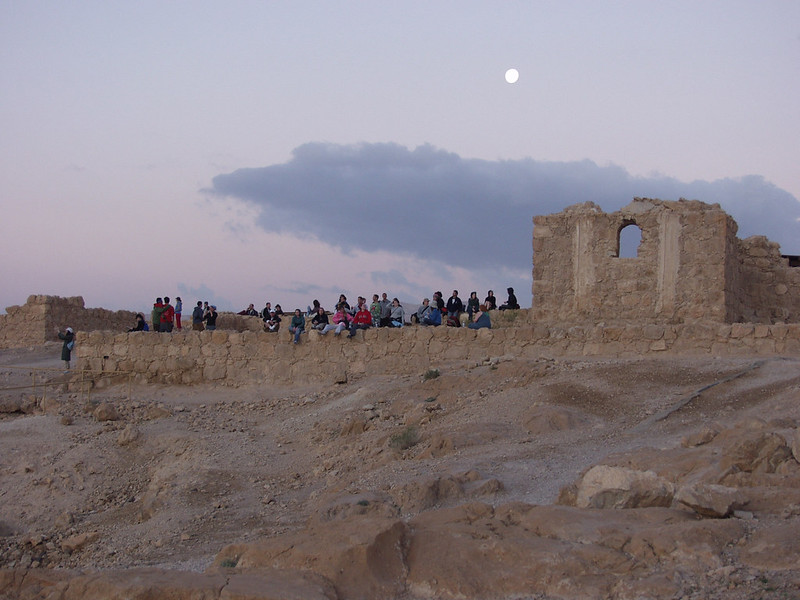
From a distance, Masada looks simple: a flat, sand-colored mountain standing alone above the western shore of the Dead Sea. Up close it holds a royal palace built into a cliff, one of the oldest synagogues ever found, the remains of a Roman siege you can still see from the top, and a story that has shaped how Israelis think about their own history.
These fourteen facts cover the history, the archaeology and a few surprises. If you are planning a visit, our Masada travel guide covers the practical side: the cable car, the walking paths and how the day fits with the Dead Sea.
The Mountain and Its Builder
1. The summit is barely above sea level. On its eastern side, Masada’s cliffs drop about 400 meters (1,300 feet) toward the Dead Sea. Yet the plateau on top sits only a little above sea level, because the whole landscape around it lies far below the level of the oceans. On the western side, facing the desert, the slope is much lower, and that is exactly where the Romans chose to attack.
2. Herod the Great turned it into a fortress palace. A smaller fortress stood here before him, but Herod rebuilt the site on a grand scale in the decades before the Common Era, as a refuge in case of a revolt at home or an attack from Egypt. He ringed the plateau with a double wall and filled it with palaces, storerooms, barracks and bathhouses.
3. The Northern Palace hangs off the cliff on three terraces. Herod’s private villa steps down the northern tip of the mountain in three levels, with views over the desert and the sea. Wall plaster painted to look like marble and the remains of columns show how much effort went into a home on the edge of a cliff.
4. Water came from rare desert floods. Masada gets almost no rain, so Herod’s engineers cut huge cisterns into the rock and channeled winter floodwater from the nearby canyons into them. There was enough water on the summit for a Roman-style bathhouse with hot, warm and cold rooms in the middle of the desert.
The Revolt and the Siege
5. Jewish rebels took the fortress in 66 CE. At the start of the Great Revolt against Rome, a group of rebels known as the Sicarii seized Masada from its Roman garrison. After the Romans destroyed Jerusalem and the Second Temple in 70 CE, more refugees joined them, and Masada became the last rebel stronghold.
6. The Roman siege works are still there. The Tenth Legion, under the governor Flavius Silva, surrounded the mountain with a wall and eight camps, then built a massive earth ramp up the western slope. From the summit you can still trace the outlines of the camps and the wall on the desert floor. They are among the most complete Roman siege works to survive anywhere.
7. Almost everything we know comes from one historian. Josephus, a Jewish commander who went over to the Roman side, wrote the only detailed account of the siege. He describes how, in 73 or 74 CE, with the ramp complete, the rebel leader Eleazar ben Yair persuaded the defenders and their families, 960 people in all, to die by their own hands rather than be captured. According to Josephus, two women and five children survived by hiding and later told the story. Historians still debate parts of his account.
8. Pottery shards may carry the defenders’ names. Archaeologists found hundreds of ostraca, pieces of pottery with writing on them, on the summit. One small group bears single names, including “ben Yair”, and some scholars believe they could be the lots Josephus says were drawn in the final hours. Others read them as ration tickets or simple labels.
Rediscovery and Excavation
9. The site was identified in 1838. After a small community of Byzantine monks left, Masada stood empty for centuries. The American scholar Edward Robinson and his companion Eli Smith identified it from a distance in 1838, and explorers reached the summit in the decades that followed.
10. Volunteers from around the world dug it out. After surveys by Shmaryahu Guttman in the 1950s, the archaeologist Yigael Yadin led a major excavation from 1963 to 1965. Thousands of volunteers from Israel and abroad answered newspaper calls to help. A black line painted along many walls separates the original stones from the parts that were rebuilt.
11. It has one of the oldest synagogues ever found. On the western edge of the plateau, the rebels used a hall as a synagogue, with stone benches along the walls. Fragments of Deuteronomy and Ezekiel were found buried beneath its floor, and part of the Book of Ben Sira in Hebrew turned up elsewhere on the summit. A small church from the Byzantine monks’ period stands on the summit too.
12. A 2,000-year-old seed sprouted. Date seeds found during the excavations were kept in storage for decades. In 2005, researchers in Israel germinated one of them, and the palm that grew, nicknamed Methuselah, is one of the oldest seeds ever brought back to life.
Masada Today
13. It is a UNESCO World Heritage Site. Masada was listed in 2001, for Herod’s palace complex, the Roman siege works and the story of the revolt. The line “Masada shall not fall again”, from a poem by Yitzhak Lamdan, became a national motto, and for decades some army units held their swearing-in ceremonies on the summit.
14. It is still a place for celebrations. Families hold bar and bat mitzvah ceremonies in the ancient synagogue, often soon after sunrise. In some years, concerts and opera productions have been staged at the foot of the mountain, and a sound and light show has been staged on the western side on some evenings.
Seeing It for Yourself
Facts come alive on the summit. A licensed guide can stand you at the edge of the Northern Palace, point out the Roman camps below, and walk you through the storerooms and the synagogue in the order the story unfolded. Most visitors go up early, especially from late spring to early autumn, when the heat builds by midmorning.
Masada usually shares a day with the Dead Sea, and often with Ein Gedi or Qumran. Our Dead Sea guide explains how to spend the afternoon.
Plan Your Visit to Masada
Masada is on almost every private itinerary we build, from first-time highlights of Israel tours to trips focused on archaeology. Our team has been planning trips in Israel since 1981, our guides are licensed by Israel’s Ministry of Tourism, and we set the pace of the day around your group, whether you want to climb at dawn or ride the cable car after breakfast.
Tell us when you are traveling and what interests you most, and we will build Masada into your route. Get a free quote.
Frequently Asked Questions
How long do you need at Masada?
Plan about three hours at the site, including the cable car and a guided walk on the summit. Most travelers combine it with the Dead Sea, Ein Gedi or Qumran on the same day.
Can you walk up Masada?
Yes. The Snake Path climbs the eastern face, and the shorter Ramp Path climbs the western side from the road near Arad. Both are best started very early, and the paths can close in the heat, so check conditions on the day.
Is the Masada story historically accurate?
The main written source is Josephus, and archaeology confirms much of the setting: the palaces, the Roman camps and the siege ramp. Some details of his account, especially the events of the final night, are still debated by historians.