
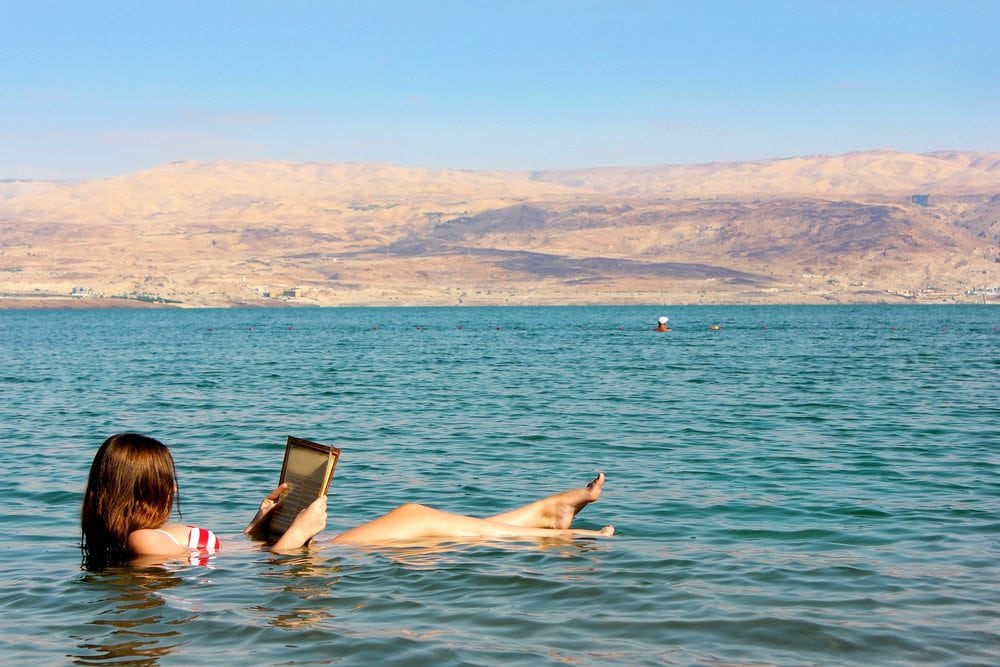
The Dead Sea is one of those places that sounds made up until you are lying on top of it, holding a newspaper above the water without trying. It is the lowest place on land on earth, it is many times saltier than the ocean, and people have been collecting its minerals, its asphalt and its mud for thousands of years.
Here are twenty facts about the lake, from its geology to its history and the challenges it faces today. For practical advice on visiting, from the beaches to what to pack, see our Dead Sea travel guide.
Geography and Geology
1. It is the lowest place on land on earth. The surface of the Dead Sea lies about 440 meters (about 1,440 feet) below sea level, and the figure grows every year as the water falls. Its shore is the lowest dry land you can stand on anywhere on the planet.
2. It is a lake, not a sea. The Dead Sea is a landlocked salt lake with no link to any ocean. Its Hebrew name, Yam HaMelach, means the Sea of Salt, and the Bible also calls it the Sea of the Arabah and the Eastern Sea.
3. It sits on the border between two tectonic plates. The lake fills a deep basin along the Dead Sea Transform, the fault where the Arabian plate slides north past the African plate. The same fault runs from the Red Sea up the Arava Valley to the Jordan Valley and the Sea of Galilee. It is often described as part of the Great Rift Valley, although geologists treat it as a separate system.
4. Water flows in but never flows out. The Jordan River, a few springs and the occasional desert flood feed the lake, but it has no outlet. Water leaves only by evaporation under the desert sun, and the salt it carried in stays behind.
5. Today’s lake is what remains of a much larger one. During the last Ice Age, a lake that geologists call Lake Lisan filled the valley from south of today’s Dead Sea to the Sea of Galilee. The pale, layered cliffs you pass on the drive to Masada are its old lake bed.
6. There is a mountain made of salt. Mount Sodom, at the southern end, is a ridge of rock salt pushed up from deep underground and capped with clay and rock. Inside it lies the Malham Cave, mapped in 2019 as the longest known salt cave in the world. A pillar on its slopes is known as Lot’s Wife, after the story in Genesis.
The Water
7. It is almost ten times saltier than the ocean. Ocean water is about 3.5 percent salt. The Dead Sea is around 34 percent, which makes it one of the saltiest bodies of water on earth.
8. That is why you float. All that dissolved salt makes the water far denser than your body, so it pushes you up to the surface. Swimming in the usual way is almost impossible; you lean back as if into an armchair.
9. Its salt is not like table salt. Most of the dissolved minerals are chlorides of magnesium, calcium and potassium, with less ordinary sodium chloride than you might expect. That mix gives the water its oily feel and bitter taste, and it stings badly in the eyes.
10. It is not completely dead. No fish or plants live in it, which is how the lake got its name, but salt-loving microorganisms do. In 2011, divers found freshwater springs on the lake floor surrounded by mats of bacteria.
History
11. Lumps of asphalt float to the surface. Natural bitumen seeps up from the bottom and drifts ashore, which is why Greek and Roman writers called it Lake Asphaltites. Chemical studies have identified Dead Sea bitumen in ancient Egyptian mummies, where it was used in embalming.
12. Cleopatra profited from the region. Ancient writers record that Mark Antony gave Cleopatra the valuable balsam groves around Jericho, near the northern end of the lake, and that Herod leased them back from her. The popular stories of Cleopatra’s own Dead Sea spas and cosmetics factories are legends.
13. Herod came here for the waters. According to the historian Josephus, Herod the Great was taken to the hot springs of Callirrhoe, on the eastern shore, during his final illness in the hope of a cure. He also built his fortress palace at Masada, above the western shore.
14. The Dead Sea Scrolls were found near its shore. Between 1947 and 1956, Bedouin shepherds and archaeologists found scrolls and fragments in caves near Qumran, close to the northwestern shore. They include the oldest known manuscripts of books of the Hebrew Bible, and some are on display at the Israel Museum in Jerusalem.
15. Ein Gedi has been an oasis for thousands of years. Fed by springs, Ein Gedi appears in the Bible as the place where David hid from Saul, and in the Song of Songs. An ancient synagogue with a mosaic floor was uncovered there, and ibex still walk the paths of the nature reserve.
The Dead Sea Today
16. The water is falling by more than a meter a year. Most of the Jordan River’s water is now used before it reaches the lake, and mineral companies on both shores pump water into evaporation ponds. The shoreline has retreated as a result, and you walk farther to the water than visitors did a generation ago.
17. The lake has split in two. As the level fell, the shallow southern basin dried out and became a series of evaporation ponds for the mineral industry. The hotels at Ein Bokek stand beside these ponds, which is why the water in front of them stays at a fairly steady level.
18. Sinkholes have opened along the shore. As the salt water retreats, fresh groundwater dissolves layers of salt underground, and thousands of sinkholes have formed. Some old beaches and roads have closed because of them, so use official beaches and stay on marked paths.
19. The air is different down here. At this depth the air pressure is slightly higher than at sea level, and the extra layer of atmosphere filters out part of the sun’s ultraviolet rays. The area has long been a center for research into climate therapy for skin conditions such as psoriasis. You can still burn, though, so use sunscreen and find shade.
20. Rain is rare. The region gets only about 50 millimeters (2 inches) of rain in a typical year, mostly in winter, often in short storms that send floods racing down the desert canyons. It is warm for most of the year and very hot in summer.
Seeing the Dead Sea
Most travelers spend an afternoon at the Dead Sea after a morning at Masada, or stay a night at a hotel at Ein Bokek for a slower pace. Our Masada guide explains how the two fit into a single day, and the Dead Sea guide covers the beaches, the mud and what to bring.
Plan Your Dead Sea Day
The Dead Sea fits into almost every route we plan, from a few hours after Masada to a slower spa and leisure trip with nights by the water. Our team has been planning trips in Israel since 1981, our guides are licensed by Israel’s Ministry of Tourism, and we adjust each day to your interests and pace, whether you want a long float, a hike at Ein Gedi or a morning at Qumran.
Tell us when you are traveling, and we will build the Dead Sea into your trip. Get a free quote.
Frequently Asked Questions
Can you swim in the Dead Sea?
You float rather than swim. Ease in, lean back, keep your face out of the water and avoid splashing, since the water stings badly in the eyes. Stay in for short stretches and rinse off in the freshwater showers.
Why is it called the Dead Sea?
Because no fish or plants can survive in water this salty. Microorganisms do live in it, and the springs and oases along its shores, such as Ein Gedi, are full of life.
Is the Dead Sea disappearing?
The level is falling by more than a meter a year because little water reaches it from the Jordan River and water is pumped out for the mineral industry. Scientists do not expect it to vanish completely, since evaporation slows as the lake shrinks and grows saltier, but the shoreline will keep moving.