Bethlehem lies only a few miles south of Jerusalem, yet it feels like a different place. Christian tradition honors it as the birthplace of Jesus, Jewish tradition as the home of King David, and its old stone town has welcomed pilgrims for well over a thousand years.
Many visitors see only the Church of the Nativity in a short stop. With half a day or more, you can walk the old city, visit the chapels and fields around it, and meet the craftspeople who have worked olive wood and mother-of-pearl here for generations. Before the list, a word on how a visit works, because it is different from anywhere else on a typical Holy Land itinerary.
How a Visit to Bethlehem Works
Bethlehem is in the West Bank, in Area A, where the Palestinian Authority is responsible for civil affairs and security. An Israeli military order bars Israeli citizens from entering Area A, and in practice this keeps most Israeli guides and drivers out. For this reason, visits from Jerusalem are usually arranged with a local Palestinian guide and transport, often meeting visitors at the checkpoint between the two cities. When you travel with us, we arrange your Bethlehem visit with a licensed local guide and transport from the checkpoint.
Bring your passport. Crossing arrangements and checkpoint hours can change at short notice, sometimes on the day itself, so it is best to confirm the plan close to your visit. Our safety and flexibility page explains how changes to a trip are handled.
1. The Church of the Nativity
Christian tradition places the birth of Jesus in a grotto beneath this church, the focus of every visit to Bethlehem. The first church here was built in the 4th century under Emperor Constantine, and most of the basilica you see today dates from a rebuilding in the 6th century, which makes it one of the oldest churches in continuous use in the world. It is a UNESCO World Heritage Site, and recent restoration has uncovered the wall mosaics high above the nave.
You enter through the low Door of Humility. Below the altar, a silver star marks the traditional spot of the birth. The church is shared by the Greek Orthodox, Armenian Apostolic and Roman Catholic communities, each with its own areas and services. Lines for the grotto can be long, so come early.
2. Manger Square and the Old City
Manger Square, in front of the basilica, is the heart of Bethlehem, with the Mosque of Omar facing the church across the plaza. From here, Star Street climbs through the old city along the route that processions still follow at Christmas.
The lanes are lined with old stone houses, small churches and workshops. This is the place to look for olive wood carvings, mother-of-pearl and embroidery, crafts that Bethlehem families have practiced for centuries.
3. St. Catherine’s Church
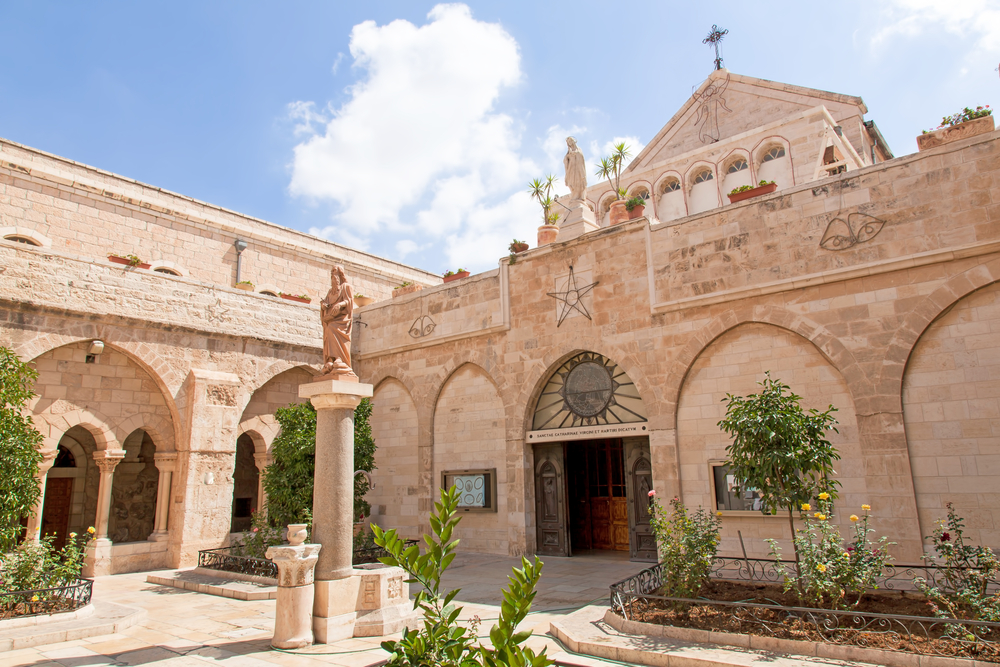
Next to the Church of the Nativity and connected to it, the Franciscan Church of St. Catherine is the Catholic parish church of Bethlehem. The Christmas Eve midnight Mass, broadcast around the world, is celebrated here.
Steps from inside the church lead down to caves linked with the Nativity grotto. One of them is traditionally associated with St. Jerome, who lived in Bethlehem in the late 4th century and translated the Bible into Latin. The quiet cloister outside, with its statue of Jerome, is a good place to pause.
4. The Milk Grotto
A few minutes’ walk from Manger Square, the Milk Grotto is a Franciscan chapel carved into soft white rock. According to tradition, the Holy Family sheltered here before fleeing to Egypt, and a drop of Mary’s milk fell to the ground and turned the stone white. Couples from many faiths come to pray here for a child. The chapel is small and calm, a contrast to the crowds at the basilica.
5. Shepherds’ Field
In Beit Sahour, just east of Bethlehem, two sites mark the fields where, according to the Gospel of Luke, angels announced the birth of Jesus to shepherds. The Franciscan chapel, shaped like a shepherd’s tent, stands among caves once used to shelter flocks. The Greek Orthodox site nearby holds the remains of a Byzantine church. Both are pleasant places for a reading and a few quiet minutes outdoors.
6. Museums and Local Crafts
Small museums in and near the old city tell the story of daily life in Bethlehem. The Baituna al-Talhami Museum on Star Street, run by the Arab Women’s Union, shows traditional homes, dress and embroidery, and the Palestinian Heritage Center displays traditional crafts and sells handmade work by local women. They are a good way to understand the town beyond its holy sites.
7. Street Art
Murals and street art cover parts of the separation barrier on the northern edge of Bethlehem, including several works attributed to the British artist Banksy. The Walled Off Hotel, a hotel and gallery opened by Banksy beside the barrier, has also drawn many visitors. It reopened in December 2025 after a two-year closure, so check what is open before you plan around it.
8. Mar Saba Monastery
East of Bethlehem, in the Judean Desert, the Greek Orthodox monastery of Mar Saba clings to the cliffs of the Kidron Valley. It was founded in the 5th century by St. Sabbas and a small community of monks still lives there, as monks have for some fifteen centuries.
By long tradition, only men may enter the monastery itself, and they need modest dress. Women can view it from the Women’s Tower and from the path across the gorge, which offers the best view of the whole complex in any case.
9. Rachel’s Tomb
At the northern entrance to Bethlehem, the tomb of the matriarch Rachel is one of the holiest sites in Judaism, and Rachel is also honored in Christian and Muslim tradition. According to Genesis, she died on the road to Bethlehem giving birth to Benjamin. Women in particular come here to pray, often for children or for a safe birth.
Rachel’s Tomb is under Israeli control and is reached from the Jerusalem side by a separate access road, not from the center of Bethlehem. It is usually visited as its own stop.
Planning Your Visit
- How long. Two to three hours cover the Church of the Nativity, St. Catherine’s and Manger Square. A full day adds Shepherds’ Field, the Milk Grotto, the old city and Mar Saba.
- What to bring. Your passport, and clothes that cover your shoulders and knees for the churches and the mosque.
- When to go. Early mornings are quietest at the Nativity grotto. Christmas brings three celebrations: the Catholic and Protestant on December 25, the Orthodox in early January and the Armenian later in January.
- Expect changes. Opening times and crossing arrangements can shift, so keep some flexibility in the day.
Bethlehem on a Holy Land Itinerary
Bethlehem is part of many Holy Land tours, usually on a day based in Jerusalem. Our trips are built around your dates, interests and pace, so if Bethlehem is on your list, mention it when you contact us and we will discuss the options for your dates.
Tell us when you are traveling and which holy sites matter most to you. Get a free quote.
Frequently Asked Questions
Can you visit Bethlehem from Jerusalem?
Yes. Bethlehem is only a few miles from Jerusalem, and many visitors go for half a day or a full day. Because most Israeli guides and drivers may not enter Area A, visits are usually arranged with a local guide and transport, often from the checkpoint.
Do I need my passport to visit Bethlehem?
Yes, bring it. You may be asked to show it when crossing the checkpoint in either direction.
How much time do you need in Bethlehem?
Two to three hours are enough for the Church of the Nativity and Manger Square. Plan a full day if you want to add Shepherds’ Field, the old city and Mar Saba.